

How to Set Up a Splitboard: A Step-by-Step Guide
There are many reasons skiers and riders choose to go into the backcountry. Whether it's for the immersion in nature, to push ourselves physically, to avoid crowded resorts, or to chase big lines, the allure of the backcountry can be hard to ignore. If you're ready to start your backcountry journey, you'll need a few things, primarily, a splitboard and avalanche safety equipment (beacon, shovel, & probe). Stepping into the backcountry can be intimidating; on top of needing to educate yourself on mountain safety with an AIARE 1 Avalanche Course, the gear can feel overwhelming. If you're ready to make the jump from the resort and have purchased a splitboard and are wondering what the hell to do next, you're in the right place. Dive in below as we outline how to set up a splitboard.
1. Lay Out All Your Gear
Start by clearing some space and organizing every component. You should have:
- Your splitboard
- Bindings and baseplates
- Touring brackets and heel risers
- Ride-mode interface (pucks or plates)
- Climbing skins with tail clips
- All screws and hardware
- A snow-specific multi-tool

Getting everything in front of you prevents mid-setup confusion and helps ensure you're not missing any hardware.
2. Determine Your Stance
Start with your splitboard together. Before mounting anything, map out your stance width and angles. If you have a resort board you like, use it as your template:
- Measure your stance width and transfer it to the splitboard via the reference marks.
- Match your binding angles—whether that's +15/–9, +12/–12, or something unique to you.
- Mark your selected inserts with tape so you don't have to re-measure later.
Your splitboard should feel familiar in ride mode, so stick with what already works for your riding.
3. Install Touring Brackets and Heel Risers
Flip each ski half base-up and locate the pre-drilled inserts.
Touring brackets:
Mount the brackets near the tips. Place the bracket, drop in the screws, and tighten evenly so it sits flat. This is what your bindings pivot on during the ascent, so proper alignment matters.
Heel risers:
Attach the heel risers using the designated inserts in the mid-ski area. These let you raise your heel for steep climbs. Make sure both ski halves match in placement and height.
A quick visual check ensures everything is straight and consistent.
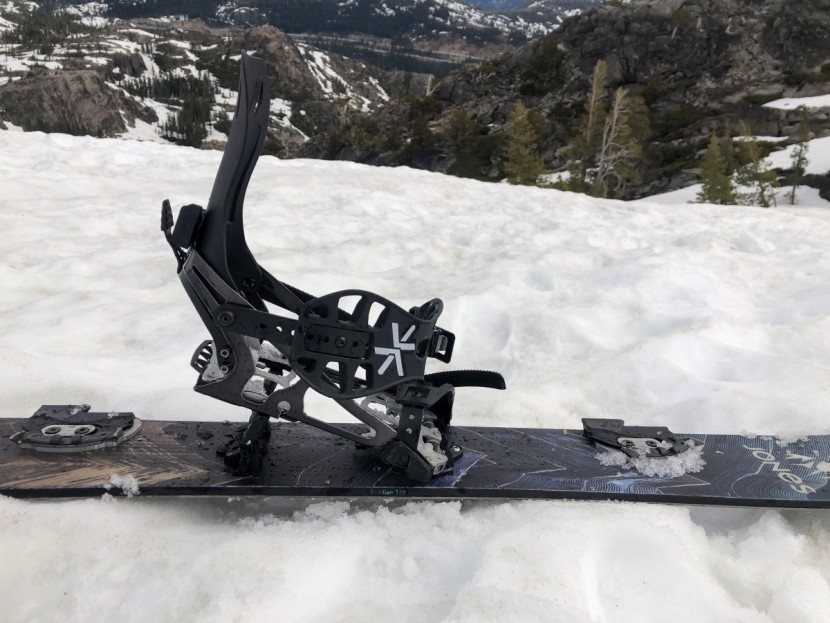
4. Mount the Ride-Mode Interface and Bindings
This is where your splitboard starts feeling like a snowboard again.
For puck-based systems (Spark, Karakoram, Voilé):
- Connect the board halves in ride mode.
- Position the pucks over the chosen inserts.
- Use alignment tools or a straight edge to ensure everything lines up correctly.
- Set your binding angles, tighten lightly, adjust, then fully secure.
For plate systems:
- Place the baseplate over your selected inserts.
- Dial in your stance angles.
- Tighten screws in a cross pattern to keep everything flush.
After mounting, clip or slide your bindings into ride mode and test for any movement. A secure lock-in is essential.
5. Fit and Trim Your Skins
Skins power the uphill, so take your time fitting them.
- Lay one ski half base-up and attach the tip loop or clip.
- Stick the skin down the center of the ski.
- Trim the edges, leaving a narrow strip of metal edge exposed for grip.
- Adjust the tail clip so it's snug but not overstretched.
Repeat with the second ski half. The skins should apply smoothly, stay centered, and peel without effort.

6. Practice Transitions at Home
Before heading into the mountains, practice your transitions in a warm, controlled environment. Familiarity here makes a massive difference. You don't want to be experimenting in the backcountry.
Tour mode:
- Separate the board halves.
- Apply skins.
- Attach bindings to touring brackets.
- Flip heel risers if needed for the grade.
Ride mode:
- Remove skins, fold them glue-to-glue, and stash them inside your jacket so they stay warm.
- Reconnect the board halves with the tip and tail clips.
- Mount the bindings in ride mode and verify that everything is fully engaged.
Run this a few times until it feels automatic.
7. Final Pre-Tour Checks
Before your first tour, do a full once-over:
- Tighten all screws with a multi-tool. Some riders even glue them in place.
- Ensure skins adhere properly in cold conditions.
- Check that poles extend and lock correctly.
- Make sure your boots interact cleanly with bindings in both modes.
- Pack a small repair kit—extra screws, skin wax, and your preferred snowboard tool.
Once everything feels dialed, take your setup on a mellow tour to confirm it performs the way you expect before heading into bigger terrain.
 Dialing in your splitboard setup takes a little time, but once everything is mounted and tested, the system becomes second nature. Start small, get comfortable with your transitions, and build confidence as you explore new zones. And as you ease into longer days outside the resort, it's worth carrying a compact tool for the inevitable minor adjustments—something like the Powder Pliers, tucked away until you need it, can quietly keep your day moving without interruption.